Sankyoku ensemble - Romainmôtier Priory
Event details
- Date
- Monday, 2 November - 20:00
- Place
- Abbatiale de Romainmôtier
- Genre
- Concerts
- Organiser
- Henosis
Description
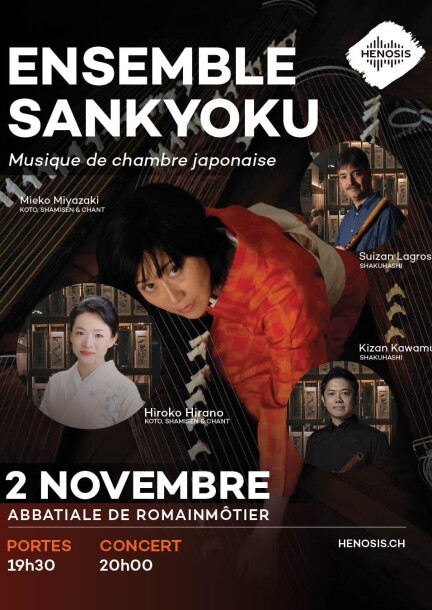
Ensemble Sankyoku This event is organised under the patronage of the Embassy of Japan in Switzerland and is part of the Automne de la culture japonaise, coordinated by the Consulate of Japan in Geneva. Japanese Chamber Music For one evening, the abbey church of Romainmôtier will resonate with the sounds of Japan. Ensemble Sankyoku brings together four exceptional performers around sankyoku, the traditional Japanese chamber music born in the Edo period in the salons of blind music masters, the kengyō. It features three emblematic instruments: the koto, a thirteen-string zither; the shamisen, a three-string lute; and the shakuhachi, an end-blown bamboo flute, joined by the voice. Detached from theatre and dance, "music for music's sake" with an emphasis on pure artistic value, sankyoku remains to this day one of the most vibrant fields of the Japanese music scene. On stage, two undisputed masters from Tokyo will enter into dialogue with two leading figures in the promotion of this music in Europe, for an encounter as rare as it is precious. Hiroko Hirano (koto, shamisen and voice), winner of the prestigious Miyagi Prize, is a professor at the Tokyo University of the Arts and a regular guest on the music programmes of the national broadcaster NHK. Kizan Kawamura (shakuhachi), grand master of the Tozan school, notably won the Grand Prix at Japan's National Traditional Music Competition in 2009. Based in France since 2005, Mieko Miyazaki (koto, shamisen and voice) pursues an acclaimed international career. She is notably behind the world-premiere transcription of Bach's Goldberg Variationsfor solo koto. Suizan Lagrost (shakuhachi), a flautist by training who became a grand master (daishihan) of the Tozan school, performs in some fifteen countries and represents the ShinTozan-ryū school in France. Whether you are a music lover, curious about Japanese culture or familiar with Japan through manga and animation, this concert is for everyone: an invitation to immerse yourself fully in a musical art rarely heard in Europe. Built around the year 1000 by the monks of Cluny, the abbey church of Romainmôtier, one of Switzerland's oldest Romanesque sanctuaries, will offer these sounds from afar the setting of its thousand-year-old stones and generous acoustics.Program 1. Midare – TurbulenceYATSUHASHI Kengyō (1614–1685)This work is among the oldest pieces of the koto repertoire that have come down to us. This may be because the koto was mainly played by blind musicians, for whom oral transmission mattered more than written notation. The composer died in the same year that Johann Sebastian BACH was born. The work can therefore be regarded as a masterpiece of Baroque music for the koto. 2. Mizu no hentai – The Metamorphosis of WaterMIYAGI Michio (1894–1956)The history of music has known exceptional figures who deeply changed the ideas of their time and helped music itself evolve. Chopin did this for the piano and Piazzolla for Argentine tango. MIYAGI Michio was one of these geniuses. He composed this work when he was only fourteen. 3. Tsuru no Sugomori – Nesting Cranesfrom the Shakuhachi HonkyokuThe term Shakuhachi Honkyoku refers to instrumental pieces for solo shakuhachi. Their origins are thought to lie in music that Zen monks practised as part of their spiritual training from the 16th century onwards. These pieces are based on the breath rather than on a regular pulse. Their musical structure is free from metrical constraints, and the way they are passed down gives a central place to their spiritual dimension. In this way they bring together some of the most fundamental elements of Japanese music. 4. Meikyō – Clear MirrorKINEYA Seihō (1914–1996)The shamisen is an essential instrument of Japanese music, yet its history in Japan is surprisingly recent. It came from mainland China and was only introduced to Japan in the 16th century. It then spread across the country with remarkable speed and quickly found a place in every form of popular culture: chamber music, theatre music, festivals and dances, and also the music played at banquets in the pleasure quarters. The nagauta shamisen used in this work is mainly associated with kabuki. Its tone and playing technique are very different from those of the instruments used for chamber music. 5. Sarashi Gensōkyoku – Fantasia on SarashiNAKANOSHIMA Kin’ichi (1904–1984)This work is by one of the great koto masters of the 20th century, alongside MIYAGI Michio. Miyagi was a great lover of Western classical music, while Nakanoshima seems to have been deeply influenced by jazz. The word sarashi refers to rinsing and bleaching linen or cotton cloth in the running water of a river. This work was traditionally done by young women. Sarashi is a recurring motif in classical Japanese music and literature, where it evokes a familiar scene of everyday life in times gone by. 6. Tsuidō – Face to FaceYAMAMOTO Hōzan (1937–2014)This shakuhachi duet was composed in 1971 by YAMAMOTO Hōzan I, a master of the Tozan school of shakuhachi and a Living National Treasure of Japan. It is still very popular today. Like manga and the martial arts, shakuhachi music has many followers around the world, and the shakuhachi is the most international of Japanese instruments. Europe even has its own association of players, the European Shakuhachi Society (ESS). Every four years, a festival held in a different country each time brings together shakuhachi players from all over the world. 7. Nebiki no matsu – The Young Pine Pulled Up by Its RootsMITSUHASHI Kōtō (c. 1780–1832)Sankyoku is an ensemble of three instruments: koto, shamisen and shakuhachi. It is the fundamental form of classical Japanese chamber music.This celebratory work demands great virtuosity. Kizan Kawamura has made a new arrangement of its shakuhachi part especially for this concert in Switzerland.We invite you to discover a masterpiece of classical Japanese music in this new version, presented here as a world premiere. Practical information Monday 2 November 2026 · Abbey church of Romainmôtier Doors 7:30 pm · concert 8 pm CHF 30 · reduced price CHF 25ParkingThe "Le Boléron" municipal parking lot, located on Rue de la Fontaine, is near the Abbey Church.
Other events by the same organiser
-
Adaya & In Gowan Ring
Friday, 13 November - 20:00
Henosis